We earn a commission if you buy through our links, at no extra cost to you.
Best Storage Shed for Trash Cans: Sizes and Fit
How to choose a storage shed for trash bins: measure your cart, check door width and lids, plus Keter Prime XL, Factor and Darwin options compared.
At a glance
To hide trash cans, the Keter Store-It-Out Prime XL is the entry-level, bin-sized cabinet and holds two 63-gallon cans per Keter. For bins plus tools, the Keter Factor 8x6 is a mid-range walk-in with a 54.5-inch entry, and the Keter Darwin 6x8 is an entry-level walk-in. Measure your own cart first.
Trash and recycling bins are the least attractive thing in most yards. They live beside the garage or along the fence, and when the weather turns, the lids fill with water, raccoons knock them over and the neighbors see them every day. A storage shed can hide them, but there is a catch: carts are bulky, they come in different sizes from town to town, and a shed that is too narrow or too shallow is worse than none. This guide shows how to measure, what to check on the shed and which of our picks can hold bins.
We did not handle any of these products. We compared the specs the manufacturers publish and left out any number they do not give. For the wider lineup, see our best storage sheds of 2026 ranking.
Measure Your Cart First
City carts are not standard. A cart called 64 gallons in one town may not have the same dimensions as one with the same label in the next county, and plenty of households have a mix of a trash cart and a recycling cart. Before you shop, get three numbers for each cart:
- Width at the widest point, usually the wheel axle or the lid hinge.
- Depth from front to back, with the lid closed.
- Height with the lid closed, and with the lid open if you want to reach in while it is inside.
Check with your city or waste hauler if you are unsure what you have, or measure the cart you own. Then compare those numbers with the shed’s interior and with the width of its door or opening. We will not say that a given shed fits a given cart size unless the manufacturer says so, because the only reliable test is your own tape measure. If the cart is larger than the shed on any side, no amount of pushing will change that.
What to Check on the Shed
Door or Lid Opening
The opening must clear the cart, with the lid closed, and leave room for your hands. Compare the cart width with the entry width the maker publishes. The Keter Store-It-Out Prime XL lists a 47.2-inch entry with front double doors and a piston-assisted lid. The Factor 8x6 lists a 54.5-inch entry, and the Darwin 6x8 lists 46.9 inches. Two carts side by side mean you need to add the widths of both and then check that the door lets you pass one at a time.
Interior Depth and Height
Carts are tall and deep. In a walk-in shed, you can place carts along a wall, but you need room to turn them. In a low cabinet, you need to compare the interior height with the cart height. The Prime XL is 43 inches high and 30 inches deep inside. The Factor is 93 inches wide, 64 inches deep and 94 inches high. The Darwin 6x8 is 69 inches wide, 92 inches deep and 84 inches high.
Floor, Threshold and Rolling
Carts roll on two wheels, so a clean, level floor and a gentle threshold matter. Keter says the Prime XL has a sloped threshold for easier movement. The pages we opened for the Factor and the Darwin do not give a threshold height, so look at the photos and measure the lip against your wheels.
Anchoring and Wind
An empty resin shed is light, and a bin cabinet is lighter still. The Prime XL weighs about 54 pounds and has 4 pre-designed anchor spots. The Factor 8x6 and Darwin 6x8 each have 8. Use them. Light sheds catch the wind, and a lid that is left open can act like a sail.
Odor and Airflow
Closed bins in a closed space get smelly in summer. Rinse the cans, tie bags tightly and keep food scraps frozen or in a separate sealed container if you can. The Factor and the Darwin list built-in ventilation according to Keter. The Prime XL page does not list ventilation and has no window.
Lock and Critters
Raccoons, dogs and mice are good reasons to put bins in a shed. Keter says all three of the sheds here are lockable, with the padlock not included. A latch that holds in wind is a decent deterrent for animals, and the Prime XL also has an additional step-on lock.
Permits, HOA Rules and Placement
Some HOAs ask for bins to be hidden, and a shed can be the fix, but you still need approval. Lifetime’s advice on its own page is to check local building codes to see whether a shed needs a permit. We did not open a code page that gives a size limit, so we will not quote one. Call your building department, check setbacks and read your HOA documents on size, color and placement. Keep the path to the curb flat and free of steps.
Shed Picks for Trash Cans
Keter Store-It-Out Prime XL: The Entry-Level Bin Cabinet
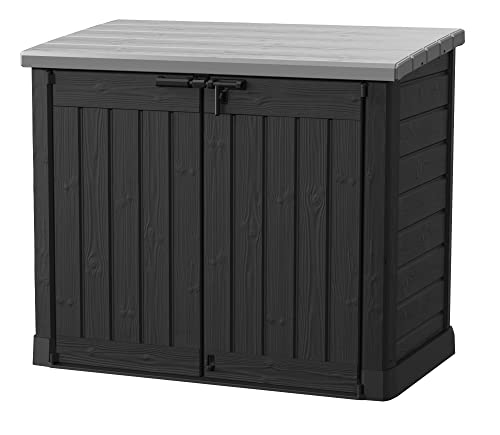
A low horizontal resin cabinet that Keter says holds two 63-gallon trash cans. An entry-level choice if bins are the problem and you do not need a walk-in shed.
This is the model built for the job. Keter states that it holds two 240-liter, 63-gallon trash cans and includes a bin-opening kit. It does not say it fits 96-gallon carts, and we will not suggest it. The numbers: 57 inches wide, 32 inches deep and 49 inches high outside, and 52 by 30 by 43 inches inside. A piston-assisted lid and front double doors with a 47.2-inch entry make it easy to reach in, and the floor includes 4 anchoring spots. It has no window and no listed ventilation, and it is not a walk-in shed. Read our Keter Store-It-Out Prime XL profile.
Keter Factor 8x6: The Mid-Range Walk-In for Bins and Gear
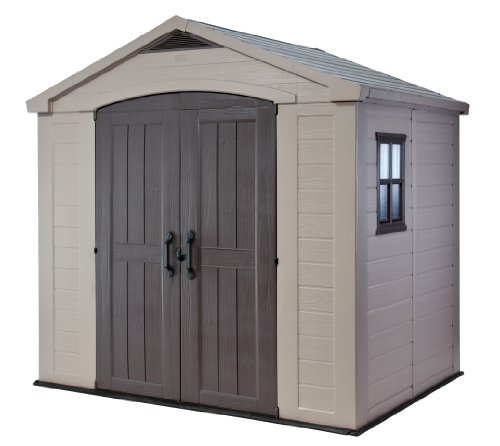
A mid-range resin walk-in with a 54.5-inch entry and 64 inches of depth. A fit if you want bins plus a mower, bikes and tools under one roof.
If your yard also needs a place for a push mower and garden gear, a walk-in makes more sense than a cabinet. Keter lists the Factor at 285 cubic feet with a 54.5-inch entry, an interior of 93 by 64 by 94 inches, a window, a skylight, built-in ventilation and two shelves. The 64-inch interior depth is the number to check against your carts, and the shelves give you somewhere to put bags and cleaning supplies. Keter does not state how many bins it fits, so measure. The Keter Factor 8x6 profile has more detail.
Keter Darwin 6x8: The Entry-Level Deep Walk-In
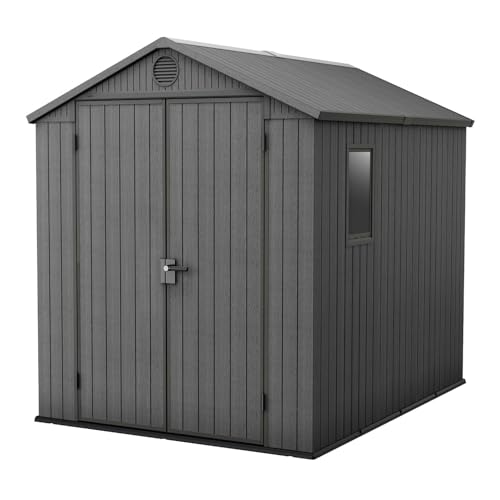
An entry-level resin shed with 92 inches of depth and a 46.9-inch entry. A choice for a long, narrow side yard where carts can line up front to back.
The Darwin 6x8 is 69 inches wide and 92 inches deep inside, with an 84-inch interior height. Its double doors are on the narrow end, and the entry is 46.9 inches wide. That makes it a candidate for carts that roll in single file and sit one behind the other. It includes a floor with 8 anchor spots, a window, a skylight and built-in ventilation. Check your cart width against the entry. We are not claiming that a specific cart size fits, because Keter does not. See the Keter Darwin 6x8 profile. The smaller Keter Darwin 4x6 has a single 25.5-inch door and is not suited to 64- or 96-gallon carts.
Quick Comparison
| Shed | Range | Type | Entry | Interior (W x D x H) |
|---|---|---|---|---|
| Keter Store-It-Out Prime XL | Entry-level | Low cabinet | 47.2 in. | 52 x 30 x 43 in. |
| Keter Factor 8x6 | Mid-range | Walk-in | 54.5 in. | 93 x 64 x 94 in. |
| Keter Darwin 6x8 | Entry-level | Walk-in | 46.9 in. | 69 x 92 x 84 in. |
How to Choose
If bins are your only concern, the Prime XL is the one built for them and the one Keter says holds two 63-gallon cans. If your carts are bigger than that, skip it and choose a walk-in, then check the door width against your carts. If you want a place for bikes, mower and tools too, the Factor 8x6 is the mid-range resin walk-in with the widest entry of the three. For a narrow strip of yard, the Darwin 6x8 gives the most depth. For other jobs, see our guide to sheds for bikes.
Sources
Frequently asked questions
How many trash cans fit in the Keter Store-It-Out Prime XL?
Keter states that the Prime XL holds two 240-liter, 63-gallon trash cans. Keter does not say it fits 96-gallon carts, so we do not claim that. The interior is 52 inches wide, 30 inches deep and 43 inches high.
Will my city's 96-gallon cart fit in a shed?
It depends on the cart's dimensions, which differ by hauler. Get the width, depth and height with the lid closed from your city or the cart maker, or measure it yourself. Then compare those numbers with the shed's interior size and door width. If a cart is bigger on any side, it will not fit.
Do I need a shed with a floor for bins?
A floor makes cleaning and rolling easier and keeps the bins off wet ground. The Prime XL, Darwin 6x8 and Factor 8x6 all include a floor, and Keter lists anchor spots on each. The floor still needs a level base underneath it.
Will a closed shed make the bins smell?
It can if bags sit in a closed space in warm weather. Rinse the cans, tie bags tightly and take out the trash on schedule. The Factor 8x6 and Darwin 6x8 list built-in ventilation per Keter; the Prime XL page lists no ventilation, so air it out regularly.
Can I put a walk-in shed beside the house just for bins?
You can, but it may be more shed than you need. A walk-in shed has to meet the same placement, permit and HOA rules as any other. Lifetime's advice is to check local building codes to see whether a shed needs a permit, and to read your HOA rules before you order.
Can the Darwin 4x6 hold trash cans?
We do not recommend it for large carts. It has a single 25.5-inch door, which is too narrow for a 64- or 96-gallon cart on wheels.